



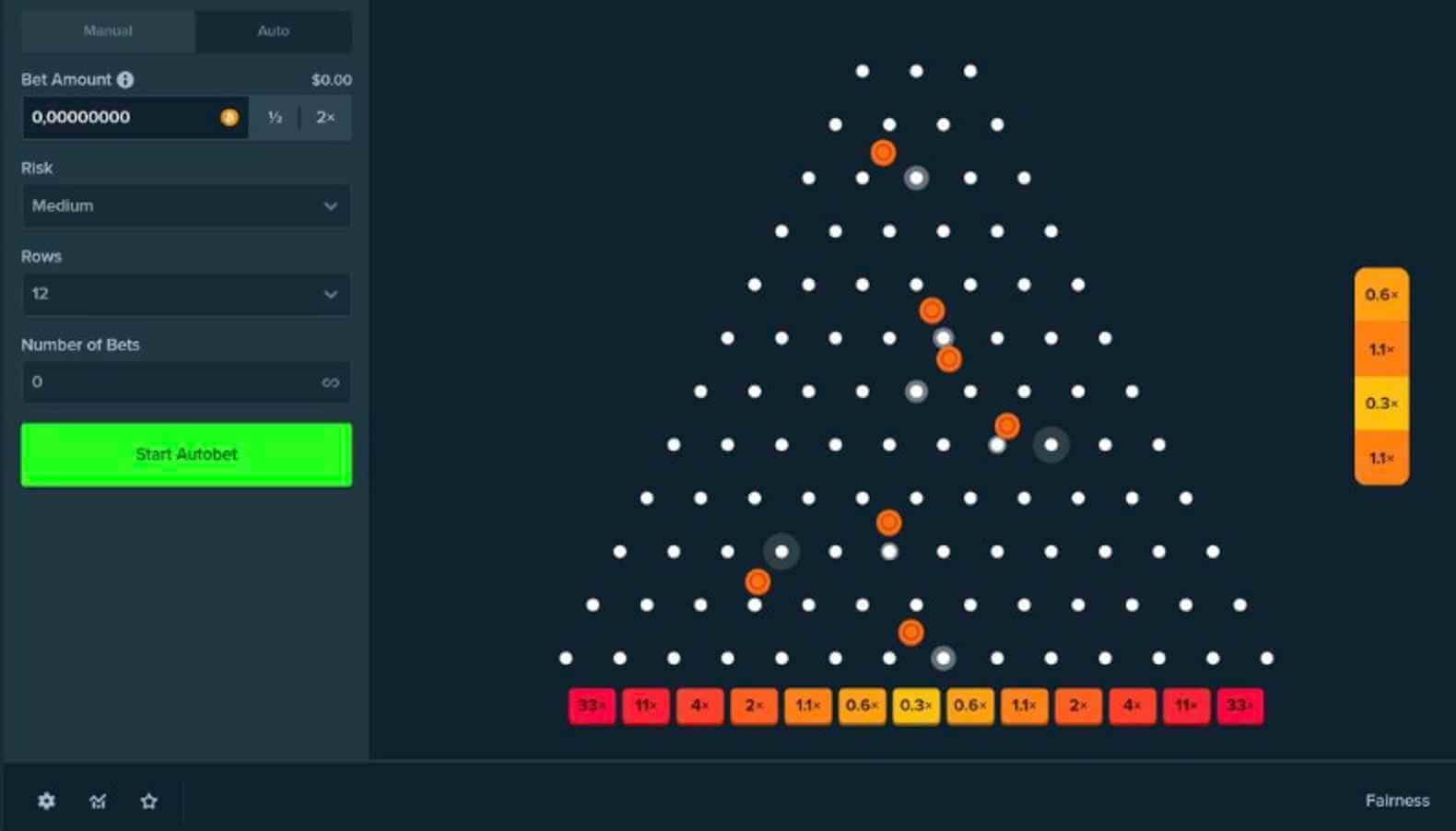
Siddharth is a seasoned analyst in the online casino industry, known for his in-depth reviews of game mechanics, volatility, and RTP performance. With years of experience studying player behavior, he offers insights that balance strategy and entertainment. His favorite title is Plinko, admired for its simplicity, unpredictability, and rewarding gameplay.
How to Play Plinko game online
Learning how to play plinko begins with a simple idea: you cannot control randomness, but you can control your choices, your budget, and your session structure. Plinko is popular because the gameplay is fast, the interface is easy, and the settings allow you to shape how steady or swingy the experience feels. This guide explains the rules, the meaning of rows and risk, how payouts are calculated, how to plan a session, and how to avoid common mistakes while keeping the experience enjoyable.
Play DEMO
Play Plinko
Like this game
- Not for me
- I like it
- I love it
Many players search for how to play plinko because they want a clean, beginner-friendly explanation that still feels practical. The goal here is not to promise winnings or push unrealistic expectations. The goal is to help you understand the mechanics and build habits that keep your sessions controlled.
Contents
- 1 What Plinko is in online casinos
- 2 How the game outcome is generated
- 3 Key settings that shape your session
- 4 Interface overview and controls
- 5 Step-by-step: how to play Plinko from start to finish
- 6 How payouts and multipliers usually work
- 7 Practical session planning
- 8 Playing styles you can use responsibly
- 9 Common mistakes and how to avoid them
- 10 Autoplay: when it helps and when it hurts
- 11 Tracking results without overcomplicating
- 12 Responsible play principles
- 13 FAQs
What Plinko is in online casinos
Plinko is a chance-based casino game inspired by a pegboard. A ball or chip drops from the top, bounces through pegs, and lands in one of the slots at the bottom. Each slot has a multiplier. Your payout is usually calculated as:
payout = bet amount × multiplier
The outcome of each drop is random. Even if two rounds use the same settings, results can vary widely. This is why players who want to learn how to play plinko should focus on understanding probability and volatility, not on trying to find patterns.
How the game outcome is generated
Online Plinko games typically rely on a random number generator (RNG). The RNG determines the outcome according to the game’s rules and probability distribution. In practical terms:
- Every drop is independent
- Past results do not influence future results
- Settings affect the distribution of multipliers, not “luck”
This is important when you are learning how to play plinko because it reduces the temptation to chase patterns. The game does not “owe” you a win after losses, and it does not “cool down” after a big hit.
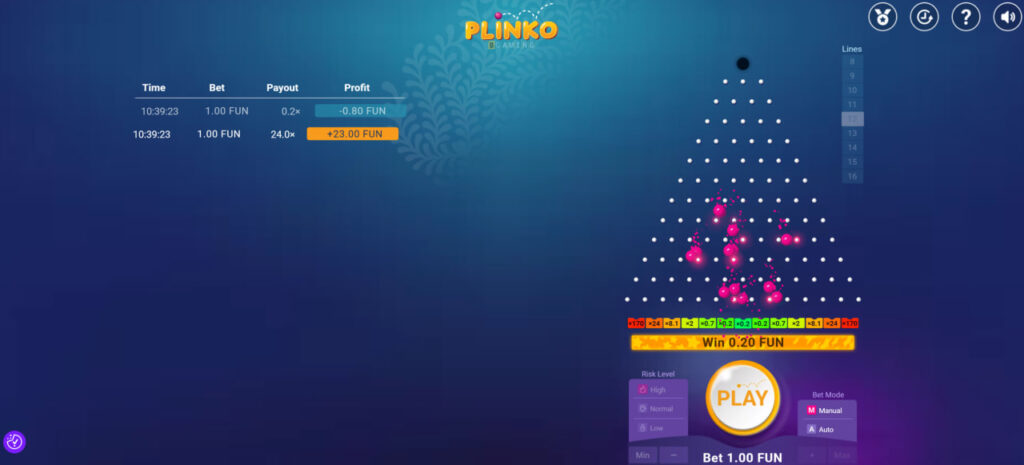
Key settings that shape your session
To understand how to play plinko game properly, you need to know the settings you can change and what they usually affect.
Rows
Rows define the height of the board and the complexity of the chip’s path. In many versions, more rows means more possible landing positions, which usually increases variance.
Typical effects of changing rows:
- Fewer rows often produce a narrower range of multipliers
- More rows can introduce wider distribution and more extreme results
- Gameplay becomes less predictable in short samples as rows increase
Risk level
Risk level is one of the most important settings in how to play plinko. Risk changes how multipliers are distributed across bottom slots.
General tendencies:
- Low risk: more frequent small multipliers, fewer dramatic swings
- Medium risk: balanced distribution for many players
- High risk: rare bigger multipliers, with longer low-return sequences possible
Bet size
Bet size is your strongest control lever. It does not change probability, but it changes how much each result matters to your bankroll.
A practical approach is to select a bet size as a percentage of your session bankroll, not as a random number.
Interface overview and controls
When people ask how to play plinko online, they often want to know what each on-screen control does. Most Plinko interfaces follow a similar design:
| Control | What it does | Why it matters |
|---|---|---|
| Rows selector | Sets the board height | Changes distribution and variance |
| Risk toggle/slider | Chooses low/medium/high risk | Changes multiplier spread |
| Bet input | Sets wager per drop | Controls bankroll exposure |
| Drop button | Starts the round | Confirms your settings |
| Autoplay (if present) | Repeats drops automatically | Helps consistency, needs strict limits |
| Balance display | Shows funds available | Prevents overspending |
| History panel | Shows recent outcomes | Useful for review, not prediction |
Knowing the interface reduces errors and makes sessions smoother, especially when you are new.
Step-by-step: how to play Plinko from start to finish
Below is a clean workflow you can repeat. It keeps decisions structured and avoids impulsive changes.
Step 1: Choose a session bankroll
Decide how much you can afford to spend. Treat it as entertainment money. Do not mix it with essential funds.
Example: if you choose $100 as your session bankroll, accept that $100 is at risk. This mindset is essential for anyone learning how to play plinko.
Step 2: Select rows
Pick a row count that matches your comfort level. Beginners often start with fewer rows or a mid-range number because it feels more stable. The exact number depends on the game version, but the principle remains the same: keep variance manageable while learning.
Step 3: Select risk level
Start with low or medium risk if you want a calmer learning experience. High risk is best approached with smaller bets and shorter sessions.
Step 4: Set bet size
A solid baseline:
- Conservative sessions: 0.5%–1% of bankroll per drop
- Balanced sessions: 1%–2%
- Higher-intensity sessions: 0.5%–1.5% even on high risk
This is where players lose control most often, so keep it simple. For many beginners, how to play plinko becomes much easier once bet sizing is consistent.
Step 5: Drop the chip
Press Drop and watch the chip fall. The result is determined, and your payout (if any) is calculated instantly.
Step 6: Review and repeat within limits
Do not change settings every few rounds without a rule. Consistency makes your results easier to evaluate and keeps emotions lower.
How payouts and multipliers usually work
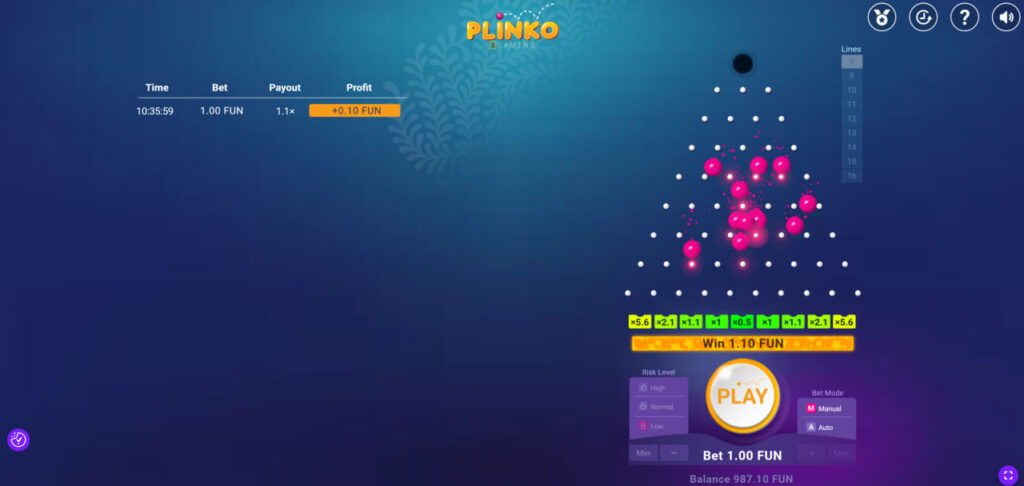
Multipliers are the payoff values at the bottom of the board. They are not equally likely. In many versions, central outcomes are more probable than extreme edge outcomes.
What players often notice:
- Low risk tends to keep more value concentrated in the center
- High risk can place very large multipliers on less frequent slots
- More rows can make the distribution feel wider
This is why how to play plinko game is really about aligning your settings with your tolerance for variance.
Practical session planning
If you want a clean system, define these limits before you begin:
- stop-loss (maximum you are willing to lose)
- win target (a realistic profit target)
- time limit or drop limit
- one main settings profile for the session
Here is a simple plan you can copy:
| Rule | Conservative example | Balanced example |
|---|---|---|
| Bankroll | 100 | 100 |
| Stop-loss | 20 | 25 |
| Win target | 10 | 15 |
| Drops limit | 200 | 150 |
| Risk level | Low | Medium |
| Bet size | 0.5–1 | 1–2 |
The specific numbers are not universal. The structure is what matters.
Playing styles you can use responsibly
These styles do not “beat” the game. They help you stay consistent.
Flat betting
Flat betting means you use the same bet size for the whole session.
Benefits:
- fewer emotional decisions
- easier tracking
- predictable bankroll exposure
For most beginners learning how to play plinko, flat betting is the cleanest approach.
Milestone step-up
Instead of increasing after losses, you increase only after reaching a profit milestone.
Example:
- Start at $1
- If you reach +$5, move to $1.20
- If you fall back under +$5, return to $1
This discourages chasing and makes increases earned rather than emotional.
Split-session method
Split sessions into two phases:
- Phase A: calmer settings for most of the session
- Phase B: higher intensity for a short, pre-defined window
Rules:
- you decide the switch point in advance
- you keep bets small in Phase B
- you end the session when limits are hit
This is a practical way to vary gameplay without turning everything into high risk.
Common mistakes and how to avoid them
Many people fail at how to play plinko not because of the rules, but because of habits.
Mistakes to avoid:
- chasing losses by increasing bet size
- switching risk level repeatedly when results feel bad
- extending sessions after hitting the win target
- playing without a stop-loss
- treating short streaks as proof of a pattern
A simple fix is to write your stop-loss and win target down before you start. If it is not written, it is easy to break.

Autoplay: when it helps and when it hurts
Some Plinko versions include autoplay. Autoplay can be useful for discipline because it keeps bet size consistent and reduces tapping impulses. But autoplay also makes it easy to lose track of time and spend faster than intended.
If you use autoplay:
- set a strict drop limit
- use smaller bets than usual
- stop immediately if you hit your loss limit or win target
- avoid changing settings mid-autoplay
For players learning how to play plinko online, autoplay is best used only after you already have strong limit discipline.
Tracking results without overcomplicating
Tracking is not about predicting the next outcome. It is about evaluating your own behavior.
Track:
- date/time
- bankroll start
- settings (rows, risk)
- bet size
- number of drops
- result
- notes on discipline
Example log:
| Session | Rows | Risk | Bet | Drops | Result | Notes |
|---|---|---|---|---|---|---|
| 1 | 8 | Low | 1 | 180 | +8 | steady, no chasing |
| 2 | 10 | Medium | 1.5 | 140 | -12 | tempted to raise bets |
After 8–10 sessions, you will see whether certain settings trigger chasing behavior. This is a key part of improving how to play plinko over time.
Responsible play principles
Plinko is entertainment. Results can swing. No method guarantees profit. A healthy approach includes:
- playing only with money you can afford to lose
- taking breaks when emotions rise
- stopping when limits are reached
- avoiding play as a solution to stress
If the game stops being fun, pause. The best decision is often to end a session early.
FAQs
To play Plinko, first choose your bet amount and, if available, select a risk level or board configuration. Then drop the chip from the top of the board and watch it bounce through pegs until it lands in a lower slot that determines your payout.

Siddharth Rao
Last updated: 16.01.2026