



Siddharth is a seasoned analyst in the online casino industry, known for his in-depth reviews of game mechanics, volatility, and RTP performance. With years of experience studying player behavior, he offers insights that balance strategy and entertainment. His favorite title is Plinko, admired for its simplicity, unpredictability, and rewarding gameplay.
Play Plinko 1000x Online in Indonesia
Plinko 1000x is a high-multiplier take on the classic drop-and-bounce casino format, built around short rounds and clearly defined risk settings. For online casino players in Indonesia, it offers a simple interface where outcomes are shaped by probability rather than complex rules.
Play DEMO
Play Plinko
Like this game
- Not for me
- I like it
- I love it
Contents
What is the 1000x variant?
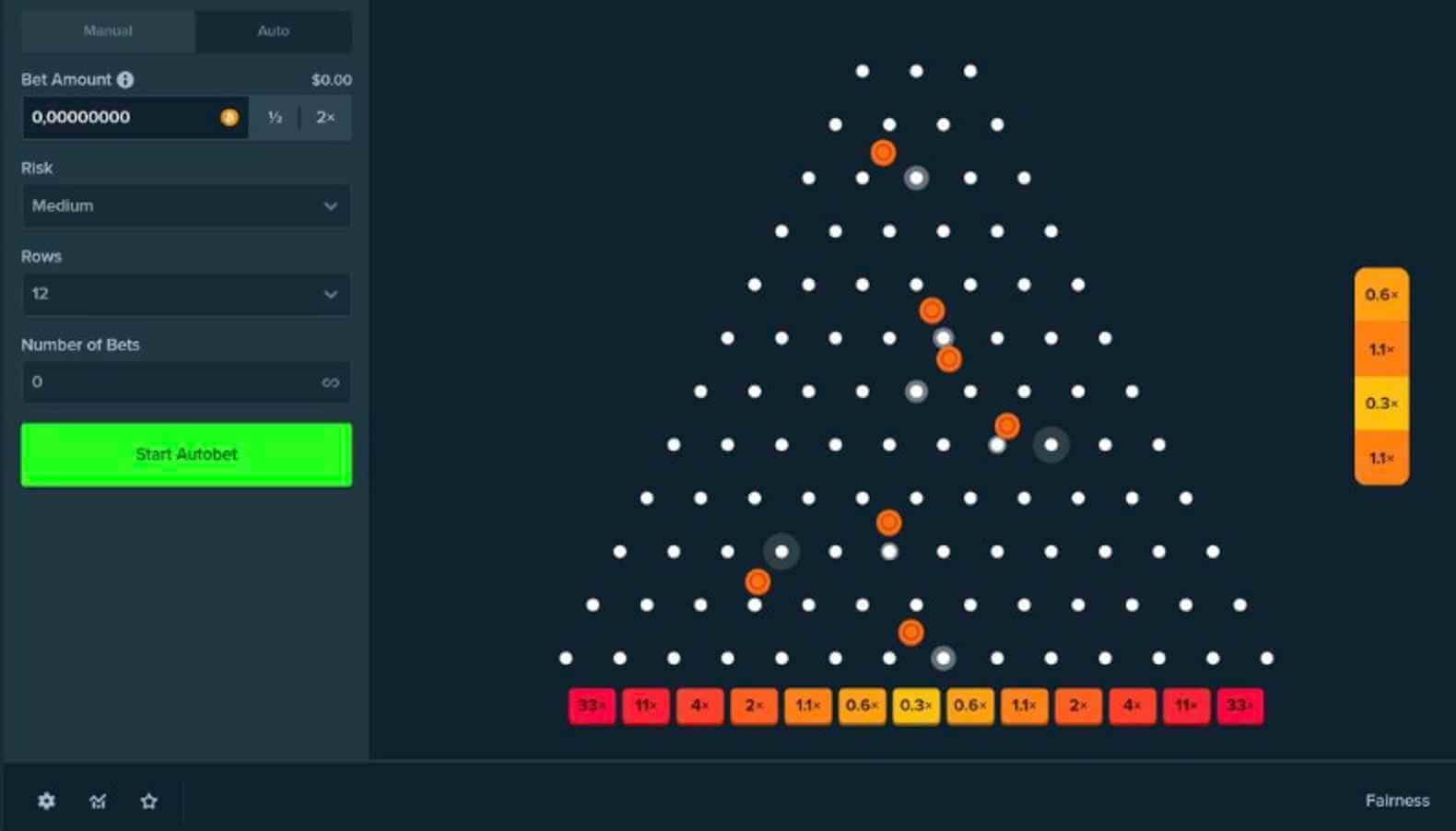
Plinko 1000x is a digital Plinko game where you release a ball (or chip) from the top of a pegged board and watch it bounce left and right until it lands in a multiplier slot at the bottom. Your return is calculated by multiplying your stake by the final multiplier, and the headline feature is that the top outcome can reach 1000x.
The game is built on a familiar idea from probability: as the ball hits pins, each bounce nudges it one step left or right. Over many drops, results tend to cluster toward the middle slots, while the extreme edges appear less often. The 1000x outcome usually sits at or near an edge, which is why it is designed to be rare. To accommodate that ceiling, the overall payout pattern often becomes more top-heavy: plenty of small outcomes, fewer mid-range multipliers, and occasional high spikes depending on the risk profile and board configuration.
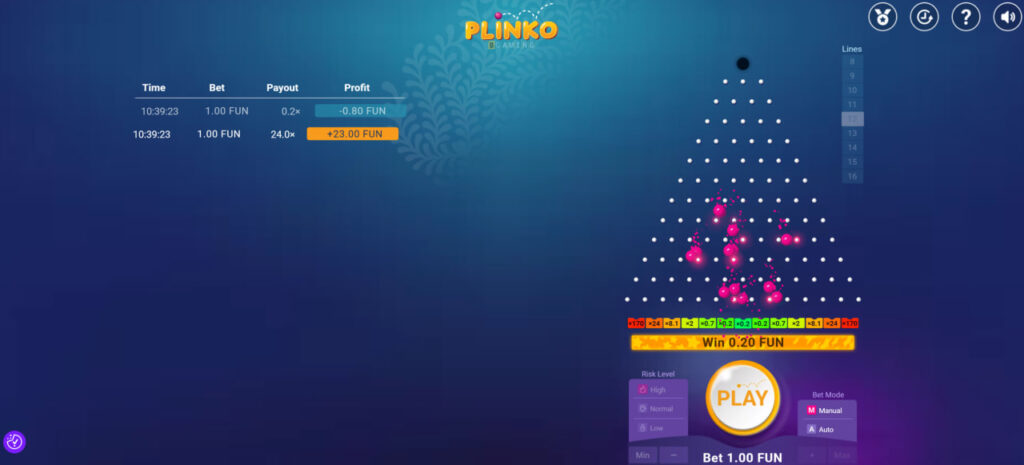
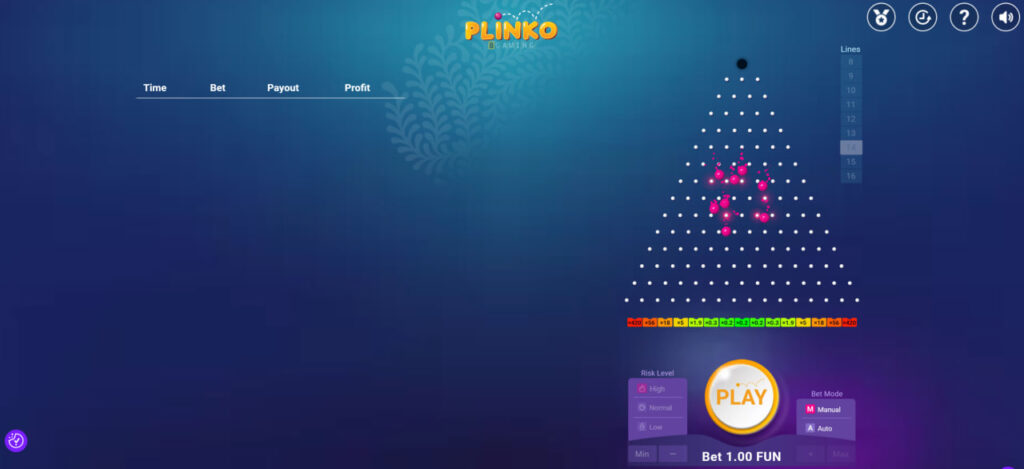
Most versions also let you adjust variables that affect how the board behaves in practice. A higher number of rows increases the number of bounces before landing, which typically makes the distribution more pronounced: more concentration around common zones and fewer landings at the extremes. Risk settings (when offered) then reshape the multiplier map across the bottom. In low risk, the game often provides more frequent modest multipliers; in high risk, it may offer more low multipliers in exchange for the chance of occasional large multipliers.
Key Features of the 1000x version
Plinko 1000x usually keeps the interface minimalist so beginners can focus on the two decisions that matter most: stake size and variance. While implementations differ by provider, the following features are common in many versions:
- Adjustable risk profiles (for example, low, medium, high) that reshape the multiplier pattern across the landing slots
- A configurable number of rows or pins, which changes the path length and the spread of likely landing positions
- Clear multiplier labels on each slot, showing the exact multiplier before you play
- Auto-play or batch-drop options to run multiple rounds with the same settings at a steady pace
- Session controls such as stop limits or round limits to help manage pace and exposure
- Instant results with round history, so you can review outcomes and settings without guessing what happened
- Mobile-friendly layouts that keep the board readable and the controls easy to use on smaller screens
From a technical perspective, most digital Plinko titles translate the ball path into a random outcome generated by the game logic, then display an animation that matches that result. The important point for players is not the animation itself, but the disclosed rules: the risk level, the board size, and the multiplier table. Those elements define the distribution you are choosing when you press drop.
Volatility in Plinko and How It Feels During Play
Volatility describes how widely results can swing around the average. In a Plinko game, the average is influenced by the game’s return model, but the emotional experience is shaped by how often you see small wins, neutral outcomes, and larger multipliers.
With Plinko 1000x, the possibility of a 1000x result usually comes with a trade-off. Higher-variance settings tend to compress the middle and push more probability toward low multipliers, while reserving a tiny slice for very large hits. As a result, sessions can feel quiet for long stretches, with occasional jumps that reset the mood instantly. Lower-variance settings typically deliver more frequent moderate results, which feels steadier even if the ceiling is less prominent in practice.
A useful way to frame volatility is distribution, not streaks. Short sequences can look uneven because random variation is normal, especially when outcomes include rare extremes. Over larger samples, results tend to reflect the intended probability curve for your chosen settings. If you pick the most aggressive configuration, it is normal for the game to feel swingy, and planning for that feeling is part of responsible play.
Tips & Strategies
No strategy can change the underlying probabilities of a Plinko game, but you can choose methods that structure your risk and make decision-making more consistent. The aim is to manage variance and pacing, not to promise a particular result.
Start with two stable variables: pick a board size and a risk level, then keep them unchanged for a meaningful sample of rounds. When players change both settings and stake sizing at the same time, it becomes hard to tell what is driving the swings. If you want to test alternatives, adjust one variable at a time and track a short note of your settings and outcomes.
Below are widely discussed staking frameworks. They should be treated as budgeting tools with strict caps rather than as winning systems:
- Flat staking: keep the same stake each round to reduce emotional reactions to streaks and keep results comparable
- Ladder staking: move the stake up or down in small, pre-set steps after defined triggers, such as a win above a chosen multiplier
- Martingale-style progression: increase the stake after losses and reset after a win; this can escalate exposure quickly, so a maximum step count is essential
- Reverse Martingale (Paroli): increase after wins and reset after a loss; this can limit loss-chasing but still requires a stop rule for streaks
- Labouchere: use a short number sequence to define targets, adjusting after each win or loss; complexity rises fast if you let the sequence grow
- Split-session method: run separate blocks with different settings, such as a low-variance block for stability and a short high-variance block for exploration
Practical guardrails matter more than the name of the method. Decide in advance on a maximum stake, a maximum number of rounds, and a clear stop point for the session. If auto-play is available, treat it as a convenience feature, not a way to override discipline. It can be helpful to add friction: for example, use smaller batches rather than continuous play so you have frequent moments to reassess.
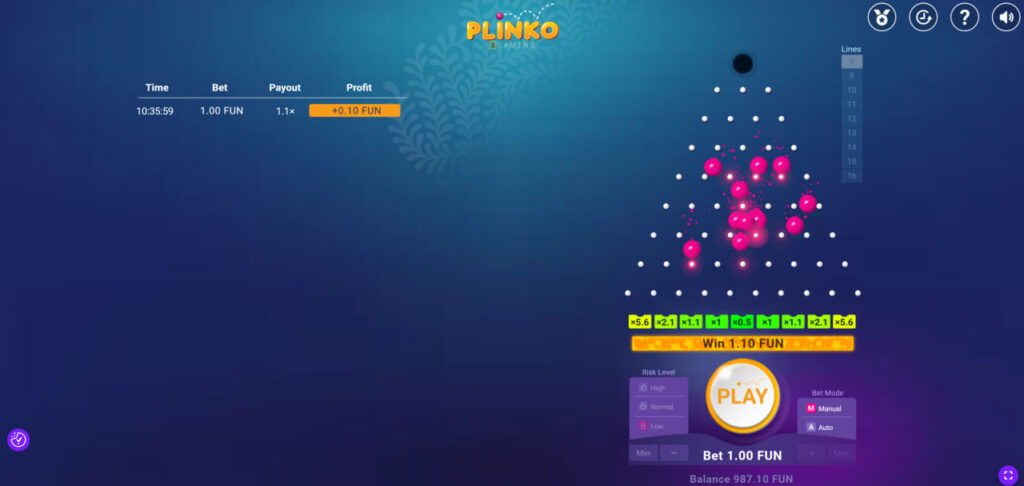
Also keep expectations realistic about the 1000x ceiling. A large multiplier is exciting precisely because it is uncommon. If you find yourself increasing stakes primarily to chase rare outcomes, it is a sign to pause and return to a plan that fits your comfort level.
Provably Fair System
Many modern Plinko titles use a provably fair framework that allows players to verify that outcomes were not altered after the round was committed. The concept is straightforward: the game commits to a hidden value (a server seed) before play, combines it with player-visible inputs, and produces an outcome through a deterministic cryptographic process. Because the process is deterministic, the same inputs always produce the same result. That makes verification possible.
In practical terms, you usually see a hashed commitment to the server seed before you play, then a client seed (chosen by the player or assigned) plus a round counter that changes each drop. After the round, the game can reveal the server seed so you can recompute the result and confirm that the revealed seed matches the prior hash and that the combined inputs lead to the published outcome. When verification is available, it typically includes all inputs needed so the calculation reproduces the exact multiplier for that round.
Provably fair does not change volatility or make large multipliers more frequent. What it provides is transparency. Instead of relying solely on trust, you can audit the process and confirm that the result is consistent with the disclosed inputs and algorithm.
Pros and Cons
| Pros | Cons |
| Simple rules that are easy to learn quickly | High outcomes can be very rare, especially at higher variance settings |
| Fast rounds and clear multiplier display | Results can feel streaky, which may frustrate players who prefer steadier feedback |
| Adjustable settings support different risk preferences | Progression systems can increase exposure if stakes rise too aggressively |
| Works well for short sessions with measurable limits | The 1000x ceiling can distort expectations if it becomes the main focus |
| Transparency is stronger when provably fair is available | Auto-play can encourage overplaying without careful stop rules |
Conclusion: Why It Appeals to Risk-Loving Players
Plinko 1000x appeals to players who want a simple decision set with a wide range of possible outcomes. The visual clarity of multipliers, the short round cycle, and the potential for a standout hit combine into a high-variance experience that feels intense without requiring complicated gameplay knowledge. For players in Indonesia who enjoy variance but still want control over pacing, it fits best when approached with clear limits, stable settings, and a focus on process rather than chasing the rare top outcome.
FAQs
Set your stake, choose the available risk and board settings, then drop a ball and receive a multiplier outcome. Your return is your stake multiplied by the landing multiplier.

Siddharth Rao
Last updated: 16.01.2026