



Siddharth is a seasoned analyst in the online casino industry, known for his in-depth reviews of game mechanics, volatility, and RTP performance. With years of experience studying player behavior, he offers insights that balance strategy and entertainment. His favorite title is Plinko, admired for its simplicity, unpredictability, and rewarding gameplay.
Play Plinko free Online in Thailand
Plinko Demo is a free-play way to learn how the Plinko game works before you decide whether real-money play is right for you. For players in Thailand, it offers a low-pressure environment to understand risk settings, multipliers, and how outcomes are generated, without depositing funds or exposing personal payment details. This article explains the core mechanics, what the demo version includes, and the practical differences you should expect versus playing with cash.
Play DEMO
Play Plinko
Like this game
- Not for me
- I like it
- I love it
Contents
What Is Plinko?
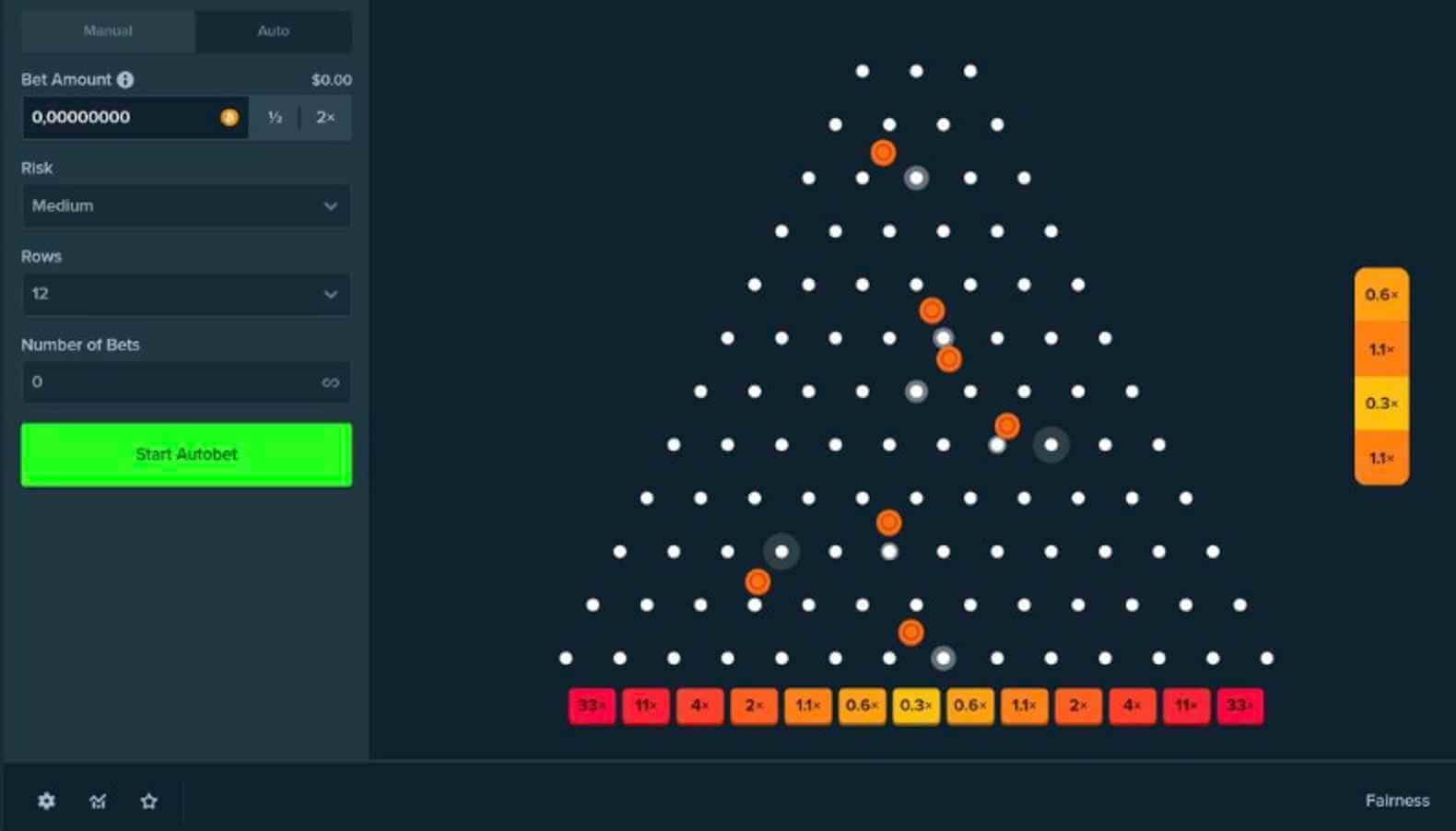
Plinko is a chance-based casino-style game inspired by the classic pegboard concept: a ball or chip drops from the top of a board, hits a series of pins, and eventually lands in a slot at the bottom. Each bottom slot is associated with a multiplier. Your result is determined by where the ball lands, and the payout is calculated as your stake multiplied by that multiplier.
Although the visuals feel simple, the experience is built around risk and volatility. Most online versions allow you to choose a risk level that changes the distribution of multipliers. Lower-risk settings typically offer more frequent small multipliers, while higher-risk settings generally introduce rarer but larger multipliers.
Many beginners first encounter the mechanics through Plinko Demo, because it presents the same board layout and decision points you see in standard play. The main skill involved is not timing or reflexes; it is understanding what each setting means for variance, session length, and expected swings.
What Is the Demo Version of Plinko?
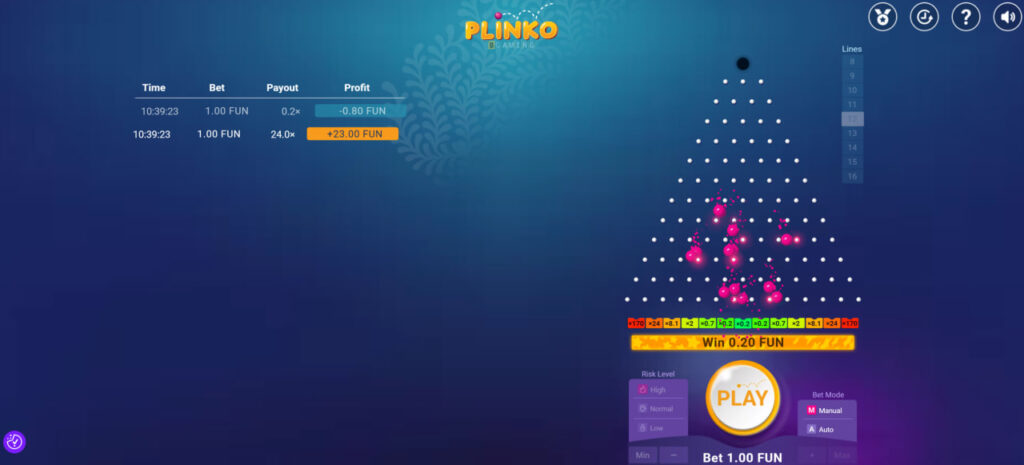
The demo version is a practice mode that simulates Plinko using virtual credits rather than real money. In most cases, you open the game, receive a sample balance, and can place test bets under the same interface as the paid version. The goal is educational: to let you explore settings, observe how results can vary, and learn the basic flow of each round.
A typical Plinko Demo session includes the core board, a bet control panel, and options such as risk or the number of rows (where available). Because it uses play credits, there is no withdrawal function and no financial upside. What you gain instead is clarity about how the game behaves over dozens or hundreds of drops, which is hard to understand from a short real-money test.
It is important to keep one limitation in mind: demo mode can mirror gameplay mechanics, but it cannot reproduce the emotional pressure of real stakes. That difference matters when you evaluate whether the game fits your risk tolerance.
Core Features of the Demo Version and Its Advantages
Because Plinko Demo is designed for learning, the value comes from controlled experimentation. You can change settings, observe patterns in outcomes, and build a more realistic expectation of how quickly balances can rise or fall under different volatility profiles.
Key features you will usually find include:
- Virtual balance that can be topped up or reset, allowing repeated tests without cost
- The same board design and multiplier structure as the standard game, supporting realistic familiarization
- Risk or volatility settings, helping you see how payout distributions can shift
- Adjustable stake controls, so you can model different bankroll sizes and bet pacing
- Fast round flow, making it easier to collect many results and understand variance
- Basic history or last-results displays, useful for reviewing recent outcomes without over-interpreting them
These features are most useful when you treat demo play as a short study period rather than as a goal in itself. The aim is to learn how the interface works and to notice how outcomes can cluster or swing, not to chase a virtual profit.
Demo Version Pros and Cons
Demo mode and real-money mode can look identical on the surface, but they serve different purposes. The table below highlights practical differences that influence how you learn and how you should interpret results.
The comparison below uses Plinko Demo as the reference point for practice play, contrasted with typical real-money mode.
| Aspect | Demo mode | Real-money mode |
| Financial risk | No financial loss, uses virtual credits | Real losses are possible and depend on stake size |
| Rewards and withdrawals | No withdrawal, results are purely informational | Potential payouts can be withdrawn based on platform rules |
| Gameplay mechanics | Usually mirrors board, multipliers, and settings | Same core mechanics, but outcomes carry real consequences |
| Purpose | Learning, testing settings, understanding variance | Entertainment with real stakes and potential returns |
| Bankroll discipline | Easier to reset and continue after a downturn | Requires budgeting and stop limits to manage risk |
| Emotional impact | Lower pressure, less stress-driven decision-making | Higher pressure can change decision-making and session control |
| Access and setup | Often available instantly, no deposit required | May require registration, verification, and a payment method |
| Promotions and restrictions | Commonly limited or not applicable | Promotions may apply, but with terms and wagering conditions |
Is the demo recommended for beginners?
For most new players, Plinko Demo is the safest starting point because it reduces the two biggest early risks: misunderstanding the settings and overestimating how stable outcomes are. A beginner can confuse short-term luck with a reliable trend, especially in a game where a few high multipliers can dramatically change a session result. Practicing first helps you see that both winning streaks and losing streaks can occur without any change in strategy.
Demo play is also useful for learning the interface. Many players lose money in real-money games simply because they click the wrong control, misunderstand the stake unit, or do not notice that a higher risk setting is enabled. A practice session lets you focus on the controls and sequence of each round.
That said, beginners should use demo mode with a clear learning objective. If you only play for entertainment, you may not notice the lessons that transfer to real-money sessions, such as how quickly a balance can decline when volatility is high.
When to move from Demo mode to Real Money Game?
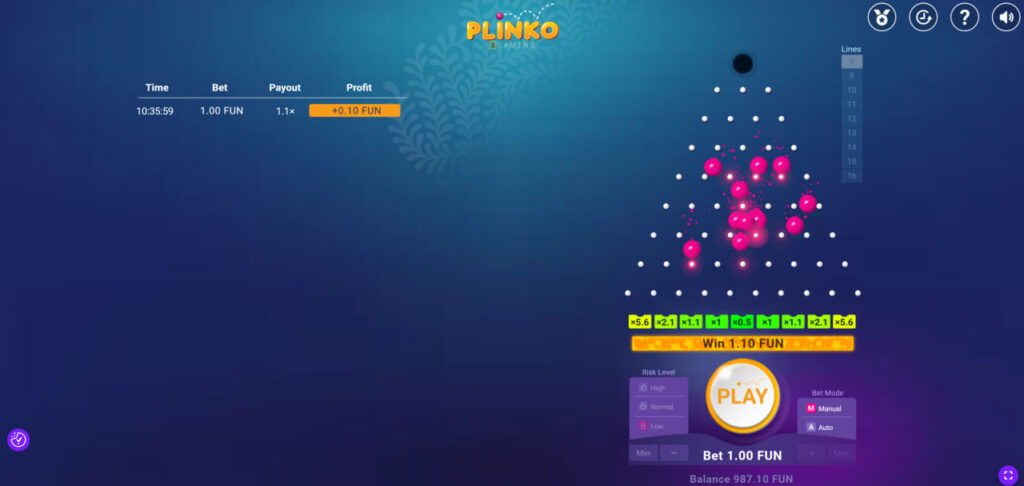
Moving to paid play is not a milestone you need to reach quickly. It is a decision that should follow preparation, budgeting, and a realistic understanding of how outcomes can vary. Before leaving Plinko Demo, you should be able to explain, in plain terms, what each setting does and how you plan to manage your bankroll.
A practical readiness checklist is:
- You can describe the difference between lower and higher risk settings and how they affect volatility.
- You have tested multiple stake sizes and understand how bet pacing changes session length.
- You have set a budget you can afford to lose and a stop point for the session.
- You understand that short streaks do not predict future outcomes and you avoid raising stakes to recover losses.
- You know the basic account steps for deposits and withdrawals in your jurisdiction, including any local currency handling that may apply in Thailand.
- You are comfortable stopping when the game no longer feels controlled or enjoyable.
If these points are not true yet, staying in demo mode longer can be the smarter choice. The goal is to reduce avoidable mistakes, not to rush into higher-risk play.
FAQs
In most modern implementations, the demo mode uses the same board layout, multipliers, and settings as the paid game. The main difference is the use of virtual credits, which removes financial risk and changes how you emotionally react to swings. Plinko Demo is therefore a reliable way to learn controls and volatility, but it cannot perfectly recreate the pressure of real stakes.

Siddharth Rao
Last updated: 16.01.2026